ADP The Franchise Foundation: Setting the stage for long term growth.pdf
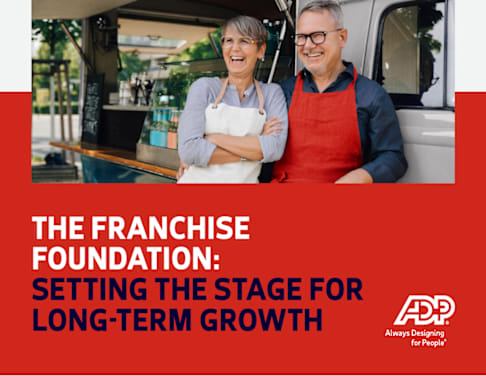
THE FRANCHISE FOUNDATION: SETTING THE STAGE FOR LONG-TERM GROWTH
4
4
7
9
13
13
15
17
19
20
20
21
2 Menu Previous Next
TABLE OF CONTENTS
PHASE 1: ACTIVATION AND OPTIMIZATION
Talent acquisition: Building your team from day one and beyond
Onboarding and training
Scheduling and labor efficiency
PHASE 2: STABILIZE AND MEASURE
Retention tracking: Understanding why people stay and why they leave
Performance optimization: Moving from busy to effective
Compliance readiness: Building structure before it becomes urgent
Continuous improvement: Turning experience into advantage
PHASE 3: FOUNDATION AND AWARENESS
Culture kickoff: Making culture intentional
Market and labor insight: Seeing beyond your four walls
3 Menu Previous Next
BUILDING THE FOUNDATION FOR LONG-TERM FRANCHISE SUCCESS Opening a franchise is an exciting milestone, one that comes with critical early decisions that shape long-term success. In the franchise industry, how you hire, onboard, schedule and support your people from the start directly impacts operational performance, guest experience and profitability.
At ADP, we work alongside franchise owners and operators every day, and we understand that early momentum matters. This guide was created to provide clarity during a complex and fast-moving stage of growth, helping you focus on the operational priorities that build stability, consistency and confidence as your business takes shape.
Successful franchise operations are built on strong foundations: the right people, supported by the right systems, guided by data and insight. When hiring practices are intentional, onboarding is structured and workforce strategies are aligned to business goals, operators are better positioned to control labor costs, strengthen retention and deliver exceptional guest experiences.
Our belief is simple: when your people strategy works, your business works. The most successful franchise leaders invest early in scalable processes that empower managers, support employees and create a culture designed for long- term growth.
If you’d like guidance tailored to your business, we invite you to contact one of our franchise strategy experts for a complimentary consultation.
4 Menu Previous Next
PHASE 1: ACTIVATION AND OPTIMIZATION
Talent acquisition: Building your team from day one and beyond For new business owners and operators, few decisions in the first few months have more impact than hiring. Your people shape everything, from guest experience and speed of service to compliance, culture, and long-term growth. Talent acquisition isn’t just about filling shifts before opening day; it’s about building a reliable, scalable workforce that can support your restaurant now and as you grow.
At its core, talent acquisition is the process of identifying, attracting, selecting and onboarding employees, while also creating a pipeline of future candidates. In an environment where turnover can be high and staffing needs change quickly, a thoughtful talent acquisition strategy helps you stay staffed, competitive and prepared for what’s next.
70% of employees who go through a through an exceptional onboarding process have the most confidence in their role.
Those same employees are 2.6 times more likely to be extremely satisfied with their workplace and, as result, are more loyal.1
Talent acquisition vs. recruiting: Why the difference matters
Recruiting is often reactive. Someone quits, sales spike, or you’re days away from opening and you need help fast. Talent acquisition takes a broader, more proactive view. It looks beyond today’s open roles and focuses on building a steady stream of candidates who are a strong fit for your brand, culture and operating model.
For franchise owners and operators, this distinction is important. While you’ll likely be hiring hourly team members in volume early on, you may also need shift leaders, managers or specialists who can step in and lead from day one. A talent acquisition mindset allows you to address immediate staffing needs while also preparing for future expansion, seasonal demand or leadership transitions.
Why talent acquisition is critical in the first 90 days
Having the right people in the right roles helps drive productivity, consistency, and customer satisfaction. Without a clear talent acquisition approach, operators often struggle to:
• Keep positions filled during peak periods
• Compete for quality candidates in tight labor markets
• Build a reputation as an employer of choice
• Reduce early turnover, especially in the first 30–45 days
Strong talent acquisition practices help you move faster without sacrificing quality and create a more stable foundation for your operation.
5 Menu Previous Next
The talent acquisition checklist
Talent acquisition doesn’t have to be overwhelming. Many successful operators follow a simple, repeatable framework:
Build a candidate network
Start early and stay visible. Engage with local communities, attend job fairs, connect with vocational schools and participate in online forums or social platforms where job seekers spend time. Even casual conversations can lead to future hires.
Recruit the right fit
Competitive pay matters, but it’s only part of the equation. Clear job descriptions, realistic expectations, and a compelling employer message help attract candidates who align with your culture. Highlight what makes your workplace unique: schedule flexibility, growth opportunities, team environment or leadership support.
Interview with purpose
Beyond job skills, look for problem-solving ability, reliability and attitude. Structured interviews help you evaluate candidates consistently while staying focused on what truly matters for the role.
Validate before you decide
Reference checks and screening tools help confirm that a candidate’s experience and work style match what you need. First impressions matter, but verification helps reduce costly mis-hires.
Make the final selection efficiently
When multiple stakeholders are involved, having a clear evaluation process helps simplify decisions and avoid delays especially when opening timelines are tight.
Onboard for retention
Onboarding is the final and often most overlooked step of talent acquisition. A strong onboarding experience helps new hires feel prepared, welcomed and confident before their first shift. This is especially critical, as a significant portion of employee turnover occurs within the first 45 days.
6 Menu Previous Next
Practical tips for optimizing talent acquisition
As you move through your first hiring cycles, monitor what’s working and adjust as needed:
Use past hiring data to estimate how long it takes to fill specific roles
Leverage technology to automate job postings and applicant communication
Keep long-term business goals in mind when evaluating candidates
Encourage employee referrals with simple incentives
Be transparent about expectations, pay and schedules
Communicate your employer brand consistently across channels
Check in frequently with new hires during onboarding and beyond
Common talent acquisition strategies in operations
Different roles require different approaches:
Bulk hiring
Opening a new location or ramping up for peak seasons often requires hiring many employees at once. Automation and standardized processes help maintain quality while moving quickly.
Leadership roles
Managers and supervisors need to lead immediately. These hires often require deeper vetting and a more proactive search.
Specialized or technical roles
Skills assessments and practical evaluations can be more effective than traditional interviews alone.
Internal hiring
Promoting from within builds loyalty and continuity — but requires visibility into employee skills and growth potential.
Learn more about how to find and hire the right employees for your growing business
https://www.adp.com/spark/articles/2025/07/how-to-find-and-hire-the-right-employees-for-your-growing-business.aspx https://www.adp.com/spark/articles/2025/07/how-to-find-and-hire-the-right-employees-for-your-growing-business.aspx
1
7 Menu Previous Next
Onboarding and training
Setting your first hire up for success
Hiring your first employee is a milestone, but onboarding them effectively is what determines whether they stay, perform and grow with your business. For new franchise owners and operators, onboarding isn’t just paperwork and training schedules. It’s your first opportunity to establish trust, set expectations and create consistency in how your business operates. A strong onboarding experience reduces early turnover, accelerates productivity and builds a foundation for long-term engagement.
At its core, effective onboarding is built on three principles: Connection, comfort and culture.
The three principles of effective onboarding
Connection
From day one, employees should feel connected to you, to their role, and to the bigger picture of the business. Connection starts before the first shift:
• A welcome message or text confirming their start date and what to expect
• Clear communication about schedules, dress code and first-day logistics
• An introduction to who they’ll be working with and reporting to
Once on the job, connection is reinforced through:
• A structured first-day plan
• Regular check-ins during the first week
• Clarity on how their role impacts the customer experience and business success
When people feel connected early, they’re more confident, engaged and motivated to show up strong.
3
2
8 Menu Previous Next
Comfort
New hires are often anxious, especially in fast-paced environments like restaurants, retail and service-based franchises. Comfort reduces friction and helps employees focus on learning, not guessing.
Comfort comes from:
• Simple, clear instructions and expectations
• Easy access to schedules, policies and training materials
• Knowing who to ask for help and feeling safe doing so
Operationally, this means:
• Digitizing paperwork so employees aren’t overwhelmed on day one
• Providing step-by-step training rather than information overload
• Giving managers tools to coach, not just correct
The faster people feel comfortable, the faster they become productive contributors.
Culture
Culture isn’t a poster on the wall; it’s what employees experience in their first few months. Onboarding is where culture becomes real:
• How leaders communicate
• How feedback is given
• How mistakes are handled
• How wins are recognized
Even small actions matter:
• Explaining why standards exist, not just enforcing them
• Modeling respect, accountability and consistency
• Reinforcing values through daily interactions
When onboarding reflects your culture, employees don’t just learn how to do the job, they learn how to belong.
Learn more about how to onboard well and why it matters
Many franchise employees are hourly and work non-traditional schedules. Onboarding needs to meet them where they are, on their phones.
Digital onboarding allows you to:
Complete paperwork before day one
Share training materials in bite-sized formats
Ensure compliance without overwhelming managers
Create a consistent experience across locations
https://www.adp.com/resources/articles-and-insights/articles/o/onboarding-new-employees.aspx?referrer=%7b0CC80485-7F3E-42A6-9BD3-A52CDFDA3907%7d
9 Menu Previous Next
Scheduling and labor efficiency
With fluctuating customer demand, a mix of full-time, part-time, and hourly employees and tight labor margins, scheduling decisions directly affect profitability, compliance, employee morale and customer experience.
Early missteps in scheduling can lead to unnecessary overtime, understaffing during peak hours, frustrated employees and service breakdowns. On the other hand, thoughtful scheduling creates structure, predictability and confidence both for you and your team.
What employee scheduling really is
Employee scheduling is the process of forecasting labor needs and assigning shifts to the employees best suited to fill them based on skills, availability and business demand.
It goes far beyond simply filling shifts. Effective scheduling balances:
• Operational demand
• Labor costs
• Employee availability and preferences
• Compliance requirements
For new franchise owners, scheduling often starts reactively. Over time, with data and structure, it becomes a strategic advantage.
Why scheduling matters early
During your first few months, you are learning:
• When your business is busiest
• Which roles are essential during peak periods
• How labor costs impact your margins
• How staffing decisions affect service quality
Without structured scheduling, many new owners fall into one of two traps:
Overstaffing, which erodes profitability
Understaffing, which damages customer experience and burns out employees
Effective scheduling helps you find balance, ensuring you have the right people in the right roles at the right times.
10 Menu Previous Next
Key benefits of structured scheduling
Putting a scheduling process in place early helps you stabilize operations and avoid costly habits.
Control labor costs
Tracking scheduled versus actual hours gives you visibility into where labor dollars are being spent and where adjustments are needed.
Manage overtime proactively
Overtime often creeps in quietly. Early visibility into trends helps you correct issues before they become the norm.
Cover time off and absences
Employees can request time off in advance and swap shifts when needed, reducing last-minute scrambling.
Schedule based on skills and certifications
Matching employees to shifts based on experience improves productivity, compliance and service consistency.
Monitor attendance and breaks
Identifying patterns like tardiness or missed breaks early allows you to address issues before morale or compliance suffers.
Support compliance
Structured scheduling supports adherence to wage- and-hour laws, break requirements, overtime rules, and local scheduling regulations.
How to approach scheduling
Successful scheduling starts with a simple, repeatable process.
1. Forecast your labor needs
Use early sales data, expected promotions, local events, holidays and even weather patterns to anticipate staffing needs. While forecasts won’t be perfect early on, they improve quickly with consistent tracking.
2. Assign shifts strategically
Collect employee availability upfront and match shifts to skills. This reduces last-minute changes and improves performance.
3. Communicate clearly
Schedules should be easy for employees to access and understand. Digital schedules and mobile communication help ensure everyone knows when and where they’re expected to work.
4. Review and adjust weekly
Track key metrics such as:
• Hours scheduled vs. hours worked
• Overtime hours
• Revenue per labor hour
Use these insights to refine future schedules and improve efficiency.
Research shows that 79% of shift workers say their schedule influences whether they stay with an employer, highlighting the direct link between scheduling and retention.2
11 Menu Previous Next
Collaborative scheduling: A modern approach
Scheduling no longer needs to be a one-way directive. Many franchises benefit from collaborative scheduling, where managers post open shifts and employees claim shifts that work best for them.
This approach:
Increases employee engagement
Reduces absenteeism
Improves coverage during high-demand periods
Employees gain flexibility, while owners maintain oversight and control.
Managing employee preferences without losing control
While accommodating every preference isn’t realistic, transparency is essential.
Best practices include:
• Being upfront about required nights, weekends or peak shifts
• Setting expectations clearly during hiring and onboarding
• Applying scheduling rules consistently
• Educating employees on policies and procedures
When employees feel treated fairly and understand the rules, scheduling conflicts decrease and trust increases.
12 Menu Previous Next
Technology as a force multiplier (not a replacement)
Scheduling software can help automate many manual tasks, reduce guesswork and process large amounts of data quickly. More importantly, it gives new franchise owners visibility, something that’s often missing early on.
Technology supports better decisions by:
• Forecasting labor demand
• Highlighting overtime risks
• Making schedule changes easier to manage
• Providing real-time insights into labor efficiency
The result is less time spent reacting and more time spent leading.
Common scheduling mistakes to avoid early
It’s important to be mindful of these common pitfalls:
• Building schedules based solely on last-minute needs
• Relying on the same employees for extra hours
• Ignoring early warning signs like frequent callouts or overtime
• Failing to document and track scheduling data
Correcting these issues early prevents larger operational challenges later.
Why this matters
Scheduling habits formed early tend to stick. By establishing structure now, you:
• Protect your margins
• Improve employee retention
• Reduce compliance risk
• Create a predictable operating rhythm
Scheduling isn’t just about coverage, it’s about setting standards that support growth, consistency and long-term success.
Learn more about employee time tracking software that can help save money and improve productivity
https://www.adp.com/what-we-offer/time-and-attendance/employee-time-tracking.aspx https://www.adp.com/what-we-offer/time-and-attendance/employee-time-tracking.aspx
13 Menu Previous Next
PHASE 2: STABILIZE AND MEASURE Within the first few months, the intensity of opening has started to settle. The initial hiring rush is behind you. Your team understands the basics. Guests are forming expectations about your location. Patterns are beginning to emerge.
This phase is where many new operators make a critical shift or miss the opportunity to do so.
In the beginning, it’s about getting open and operational. The next phase is about understanding what’s actually happening inside your business and making adjustments before small problems become expensive habits.
In this phase, your focus moves from activity to insight:
Who is staying and who is leaving?
Where are performance gaps appearing?
Are processes compliant and repeatable?
How do we improve without overwhelming the team?
This is where your operation begins to mature.
Learn how Thrive Restaurant Group reduced turnover 57% with ADP HCM
Retention tracking: Understanding why people stay and why they leave Hiring gets attention. Retention builds businesses.
In the QSR industry, turnover is often treated as unavoidable. Some level of movement is expected. But high turnover early is rarely just a staffing issue; it’s usually a signal.
Understanding why people leave is one of the most valuable insights a new operator can gain in the first 60 days.
Retention measures who stays. Turnover measures who leaves. Both tell a story about your organization.
Why retention matters early
Employees who stay longer:
• Learn systems faster
• Deliver more consistent guest experiences
• Require less supervision
• Strengthen team morale
• Reduce recruiting and training costs
Research estimates the cost of replacing an employee can reach up to 50% and 200% of annual salary when recruiting,3 onboarding and lost productivity are considered. In a restaurant environment, the hidden costs, morale, consistency and lost experience can be even greater.
Retention isn’t just an HR metric. It’s an operational advantage.
https://www.adp.com/resources/what-others-say/testimonials/h/how-thrive-restaurant-group-reduced-turnover-57-percent-with-adp-hcm.aspx https://www.adp.com/resources/what-others-say/testimonials/h/how-thrive-restaurant-group-reduced-turnover-57-percent-with-adp-hcm.aspx
1
2
3
14 Menu Previous Next
Understanding why employees leave
The most common reasons for voluntary turnover include:
Personal reasons or life changes
Accepting another job
Relocation or commuting challenges
Compensation and overtime concerns
Limited growth opportunities
Some reasons are outside your control. Others are signals worth paying attention to.
For example, “personal reasons” may truly reflect life changes — or it may indicate scheduling challenges, management issues or unclear expectations. Patterns matter more than individual cases.
Learn how to give your employees a competitive advantage: affordable benefits
Retention is influenced by three forces:
The market
When the economy is strong and jobs are plentiful, employees have more options. Retention becomes harder and more important.
The organization
Culture, leadership behavior, compensation, scheduling fairness and growth opportunities all shape how employees experience work.
The employee
Life stage matters. Younger employees tend to move more frequently, while employees later in their careers prioritize stability and environment.
The goal isn’t to prevent all turnover. It’s about understanding what’s controllable and improving it.
With practical retention tracking, start simple:
• Track voluntary vs. involuntary turnover
• Identify when employees leave (first 30, 60 or 90 days)
• Conduct short exit conversations
• Search for patterns by shift, manager or role
Early awareness allows you to correct issues before they become cultural norms.
Learn more about getting talent retention right and what data to track
https://www.adp.com/resources/articles-and-insights/articles/c/competitive-employee-benefits-with-a-peo.aspx https://www.adp.com/resources/articles-and-insights/articles/c/competitive-employee-benefits-with-a-peo.aspx https://www.adp.com/spark/articles/2018/06/getting-talent-retention-right-what-data-to-track.aspx https://www.adp.com/spark/articles/2018/06/getting-talent-retention-right-what-data-to-track.aspx
15 Menu Previous Next
Performance optimization: Moving from busy to effective
By the second month, most teams are working hard. The next step is making sure they’re working effectively.
Performance optimization isn’t about pushing people harder. It’s about equipping people to succeed.
Strong performance environments share three characteristics:
• Clear expectations
• Continuous feedback
• Ongoing learning
Aligning performance with business goals, every role in a restaurant connects to outcomes:
• Speed of service
• Order accuracy
• Guest satisfaction
• Labor efficiency
Managers should focus on:
• Setting clear daily expectations
• Providing real-time feedback
• Recognizing progress, not just correcting mistakes
When employees understand how their work affects results, performance naturally improves.
Continuous coaching is far more effective than periodic correction.
Using data to improve performance
Modern workforce tools allow operators to uncover:
• Team strengths and skill gaps
• Productivity trends
• Scheduling efficiency
• Individual performance patterns
This visibility allows managers to coach intentionally rather than react emotionally.
Performance optimization also includes learning flexibility. Some employees learn best through observation, others through repetition or hands-on practice. Providing multiple training approaches accelerates development and builds confidence.
16 Menu Previous Next
Using labor analytics data
Labor analytics help franchise operators make smarter hiring and compensation decisions by replacing guesswork with real-time market insight. By leveraging compensation benchmarking and workforce data, businesses can align pay strategies with current labor trends, attract qualified talent and retain employees while maintaining financial discipline.
Compensation benchmarking analyzes market salary and hourly wage data to ensure pay rates remain competitive, equitable and consistent with industry standards. This is especially critical in today’s dynamic labor environment, where workforce expectations and hiring conditions change quickly across regions and roles.
Using people analytics solutions, operators gain access to real-time insights into labor market trends, talent availability and hiring practices. These insights allow leaders to balance two competing priorities: Offering compensation strong enough to attract top talent while staying within budget and maintaining internal pay equity.
Ultimately, labor analytics provides clarity while helping franchise owners confidently determine what to pay, where to compete for talent and how to build a sustainable workforce strategy that supports long-term growth.
Learn more about compensation benchmarking with data covering more than 30 different pay and HR metrics
AI and the changing workforce
Technology, including artificial intelligence (AI), is increasingly becoming a support tool rather than a replacement for employees. In the quick service restaurant (QSR) environment, AI can help automate repetitive tasks, provide insights and reduce administrative workload, giving managers more time to lead.
The most successful operators position technology as augmentation:
• Helping employees focus on guest experience
• Reducing manual processes
• Supporting better decision-making
People still matter most. Technology simply helps them perform at their best.
https://www.adp.com/resources/articles-and-insights/articles/c/compensation-benchmarking.aspx
17 Menu Previous Next
Compliance readiness: Building structure before it becomes urgent
Compliance often feels invisible until something goes wrong.
For many franchise operators, the early focus is on sales, staffing and daily operations. But building a profitable, sustainable business also requires a strong compliance foundation. When the right processes are in place early, compliance becomes part of your operational rhythm rather than a disruption that appears during an audit, investigation or unexpected issue.
In a restaurant environment, compliance affects many parts of the business, including:
• Payroll accuracy and wage laws
• Overtime and break requirements
• Proper employee classification
• Employee documentation and onboarding records
• Benefits and tax compliance where applicable
Establishing clear, consistent processes in these areas helps reduce administrative burden and builds trust with your workforce. Employees who are paid correctly, scheduled fairly and understand company policies are more engaged, more confident in their employer and ultimately more likely to stay.
Compliance isn’t just about avoiding risk, it’s about creating a structure that supports growth.
Understanding available tax credits and incentives
Many franchise operators are surprised to learn that compliance readiness can also unlock financial opportunities. Federal, state and local programs often offer tax credits and incentives designed to support hiring, training expansion and investment.
Understanding these programs early can help reduce operating costs while supporting strategic growth.
Employment-based credits
Employment credits are designed to encourage businesses to hire individuals from targeted groups that may face employment barriers. One of the most widely known programs is the Work Opportunity Tax Credit (WOTC), which provides incentives for hiring eligible candidates such as veterans, individuals receiving certain public assistance benefits or those who have experienced long-term unemployment.
Training incentives
Some states offer incentives tied to employee training programs. These benefits can apply to training you may already be planning, such as implementing a new point-of- sale system, introducing new equipment, adopting updated processes or rolling out new technology. Programs in states such as Georgia and California are particularly well known for providing meaningful training-related incentives.
Geographic incentives
Certain federal, state and local programs are designed to stimulate economic growth in designated areas. Businesses operating within Enterprise Zones, Empowerment Zones or Opportunity Zones may qualify for incentives tied to hiring, investment or business expansion.
18 Menu Previous Next
Job creation credits
Many states offer credits to businesses that create new jobs or expand their workforce. These programs often reward companies for opening new locations or increasing headcount at existing facilities. In some cases, the value of these credits can be significant, sometimes reaching tens of thousands of dollars per newly created job. Some states even allow these credits to offset payroll taxes.
Investment credits
Businesses that invest in new equipment, technology or facility upgrades may also qualify for investment-based credits. These incentives typically range from 1–10% of the total investment value and can become substantial when organizations invest in large operational improvements or facility upgrades.
Negotiated economic development incentives
For companies planning significant growth or expansion, additional incentives may be available through state or local economic development agencies. These programs often require early planning and negotiation before public announcements are made or final location decisions are finalized. When structured effectively, negotiated incentives can support the development of new facilities, job creation and long-term business growth.
Additional opportunities may include:
• Research and Development (R&D) credits for investments in new technologies or operational processes
• State and local tax incentives designed to support hiring and workforce expansion
• Transferable tax credits, which can be sold or purchased to help reduce tax liability
• Economic development programs that support new facilities, employment growth and capital investment
The goal: Consistency, not complexity
The objective during this phase of your franchise journey isn’t to build a complicated compliance system. It’s to establish consistent processes that protect your business and position it for growth.
When compliance, documentation and incentive programs are managed proactively, operators gain something invaluable: confidence that the business they’re building is not only profitable today, but structured to scale successfully tomorrow.
Learn more about integrating compliance and HCM solutions
https://www.adp.com/resources/articles-and-insights/articles/c/compliance-partners-and-integrations.aspx?referrer=%7bF2EE5E0F-73BB-4A2C-92DE-712C22CF9377%7d https://www.adp.com/resources/articles-and-insights/articles/c/compliance-partners-and-integrations.aspx?referrer=%7bF2EE5E0F-73BB-4A2C-92DE-712C22CF9377%7d
19 Menu Previous Next
Continuous improvement: Turning experience into advantage By the first three months, your business has generated enough real- world experience to start improving intentionally.
Continuous improvement is not about constant change. It’s about small, consistent adjustments based on what you’ve learned.
Ask regularly:
• What slowed us down this week?
• Where are mistakes repeating?
• What do our strongest people do differently?
• What can we simplify?
When people strategy becomes intentional rather than reactive, everything else improves:
Strong employees stay longer
Teams become more confident
Managers spend less time solving the same problems
Operators who treat people strategy as a competitive advantage instead of a checkbox build more resilient businesses.
Phase 2 recap: From activity to insight
Mark the transition from opening energy to operational awareness by focusing on:
• Understanding retention patterns
• Optimizing performance through coaching and clarity
• Establishing compliance structure
• Creating a mindset of continuous improvement
You move your business from simply running to running well.
This phase creates stability. The next phase creates identity.
20 Menu Previous Next
PHASE 3: FOUNDATION AND AWARENESS Your team has rhythm. Guests recognize your location. Operational patterns are clearer.
Now the focus shifts again, from stabilization to foundation.
The question in this phase becomes:
What kind of workplace and business are we building long-term?
Culture kickoff: Making culture intentional Culture forms whether you design it or not, and culture develops through urgency and necessity. Make it intentional.
Culture shows up in:
• How managers communicate under pressure
• How mistakes are handled
• How success is recognized
• How new employees are welcomed
Employees decide early whether a workplace feels supportive, fair and worth committing to. Culture is what turns a job into a place people choose to stay.
Starting your culture conversation
Culture kickoff doesn’t require formal programs. It starts with clarity:
• What standards matter most?
• How do we treat guests and each other?
• What behaviors do we reward?
Small actions matter:
• Recognizing strong performance publicly
• Coaching privately and respectfully
• Explaining the “why” behind standards
When culture is consistent, performance follows. Connect people with their work and create a better employee experience. When your people connect with their work, they are proven to be more engaged and productive. From acquisition to activation, you should:
Create an engaging candidate experience that conveys your unique employment brand and culture from the beginning
Make it simple for new employees to connect to their teams and have a defined path to speed their time to contribute
Identify and develop every employee’s unique strengths, skills and competencies, helping them to work with purpose
Learn more about a strengths-based approach to talent that drives your people to discover their unique edge and win at work
https://www.adp.com/what-we-offer/products/standout.aspx https://www.adp.com/what-we-offer/products/standout.aspx
21 Menu Previous Next
Market and labor insight: Seeing beyond your four walls Your business doesn’t exist in isolation. Labor markets, competitors, wage trends, and local economic conditions all influence hiring, retention and profitability.
Understanding your market helps answer important questions:
• Are we paying competitively for our area?
• Are competitors hiring aggressively nearby?
• How does commute distance affect staffing?
• Are labor shortages temporary or structural?
Benchmarking against broader labor data provides context for decisions that might otherwise feel reactive.
Strategic workforce awareness allows you to plan instead of chase.
Building awareness early
Operators who develop market awareness early can:
• Adjust hiring strategies before shortages occur
• Set realistic labor expectations
• Identify growth opportunities
• Strengthen retention during competitive hiring periods
Awareness turns experience into foresight.
Building the foundation for what comes next
After completing the transition from opening a business to leading an organization you should focus on:
• Establishing intentional culture
• Understanding your market and labor environment
• Aligning people strategy with business goals
You create a foundation that supports sustainable growth.
At this phase, your operation moves beyond survival and into awareness. This is where decisions become proactive, leadership becomes clearer and your team begins to take ownership alongside you.
The first 90 days don’t define your success. But they define the foundation on which everything else will be built.
22 Menu Previous Next
Final thoughts
Opening and scaling a franchise takes focus, discipline, and the ability to make smart decisions early. The foundation you build in your first 90 days, especially around your people, processes and systems, will shape your long-term success.
Use this guide as a roadmap to establish consistency, strengthen your workforce strategy and create operational stability. As your business grows, refine your approach, uncover new opportunities and stay aligned with your goals.
Most importantly, remember, you don’t have to build it alone. The most successful operators surround themselves with the right partners, tools and insights to support sustainable growth.
Scaling your business requires more than adding locations — it requires systems and support designed to grow with you.
To explore proven strategies, insights, and tools built for franchise operators, visit: https://resources.adp.com/partnerhq
Or connect with a Franchise Strategy Specialist for a complimentary, tailored discussion on your growth goals, email us at: Globalfranchiseandaffiliations@adp.com
Additional resources
HCM buyer’s guide Market and labor insight
1. Gallup. 8 Practical Tips for Leaders for a Better Onboarding Process. 2021 2. Shiftboard, The State of the Hourly Worker Report, June 29, 2023 3. SHRM, “The Myth of Replaceability: Preparing for the Loss of Key
Employees,” January 21, 2025.
ADP, the ADP logo and Always Designing for People are trademarks of ADP, Inc. All other marks are the property of their respective owners. Copyright © 2026 ADP, Inc. All rights reserved.
https://resources.adp.com/partnerhq mailto:Globalfranchiseandaffiliations@adp.com https://www.adp.com/resources/articles-and-insights/articles/h/hcm-buyers-guide.aspx https://www.adpresearch.com/
Phase 1: Activation and Optimization Talent acquisition: Building your team from day one and beyond Onboarding and training Scheduling and labor efficiency
Phase 2: Stabilize and Measure Retention tracking: Understanding why people stay and why they leave Performance optimization: Moving from busy to effective Compliance readiness: Building structure before it becomes urgent Continuous improvement: Turning experience into advantage
Phase 3: Foundation and Awareness Culture kickoff: Making culture intentional Market and labor insight: Seeing beyond your four walls
Accessibility Report
Filename:
ADP_GES_Franchise Ebook_20260528.pdf
Report created by:
Tim Paul
Organization:
[Personal and organization information from the Preferences > Identity dialog.]
Summary
The checker found no problems in this document.
Needs manual check: 0
Passed manually: 2
Failed manually: 0
Skipped: 0
Passed: 30
Failed: 0
Detailed Report
Document
Rule Name Status Description
Accessibility permission flag Passed Accessibility permission flag must be set
Image-only PDF Passed Document is not image-only PDF
Tagged PDF Passed Document is tagged PDF
Logical Reading Order Passed manually Document structure provides a logical reading order
Primary language Passed Text language is specified
Title Passed Document title is showing in title bar
Bookmarks Passed Bookmarks are present in large documents
Color contrast Passed manually Document has appropriate color contrast
Page Content
Rule Name Status Description
Tagged content Passed All page content is tagged
Tagged annotations Passed All annotations are tagged
Tab order Passed Tab order is consistent with structure order
Character encoding Passed Reliable character encoding is provided
Tagged multimedia Passed All multimedia objects are tagged
Screen flicker Passed Page will not cause screen flicker
Scripts Passed No inaccessible scripts
Timed responses Passed Page does not require timed responses
Navigation links Passed Navigation links are not repetitive
Forms
Rule Name Status Description
Tagged form fields Passed All form fields are tagged
Field descriptions Passed All form fields have description
Alternate Text
Rule Name Status Description
Figures alternate text Passed Figures require alternate text
Nested alternate text Passed Alternate text that will never be read
Associated with content Passed Alternate text must be associated with some content
Hides annotation Passed Alternate text should not hide annotation
Other elements alternate text Passed Other elements that require alternate text
Tables
Rule Name Status Description
Rows Passed TR must be a child of Table, THead, TBody, or TFoot
TH and TD Passed TH and TD must be children of TR
Headers Passed Tables should have headers
Regularity Passed Tables must contain the same number of columns in each row and rows in each column
Summary Passed Tables must have a summary
Lists
Rule Name Status Description
List items Passed LI must be a child of L
Lbl and LBody Passed Lbl and LBody must be children of LI
Headings
Rule Name Status Description
Appropriate nesting Passed Appropriate nesting
Back to Top Next: Botón 218: Botón 219: Menu 19: Botón 216: Botón 217: Menu 18: Check Box 1: Off Check Box 2: Off Check Box 3: Off Check Box 4: Off Check Box 5: Off Check Box 6: Off Botón 215: Botón 238: Menu 17: Botón 220: Botón 221: Menu 16: Botón 222: Botón 223: Menu 15: Botón 224: Botón 225: Menu 14: Botón 234: Botón 235: Menu 13: Botón 232: Botón 233: Menu 12: Botón 230: Botón 231: Menu 11: Botón 228: Botón 229: Menu 10: Botón 226: Botón 227: Menu 9: Botón 242: Botón 243: Menu 8: Botón 244: Botón 245: Menu 7: Botón 246: Botón 247: Menu 6: Botón 248: Botón 249: Menu 5: Botón 250: Botón 251: Menu 4: Botón 252: Botón 253: Menu 3: Botón 254: Botón 255: Menu 2: Botón 256: Botón 257: Menu 1: Botón 258: Menu: Botón 259: Menu 20: